
Recorders
The recorder differs from a penny whistle in a few ways. it has eight holes (seven finger holes and a thumb hole). Two of the holes are usually smaller double-holes, making it easier to half-hole these notes.
If you already play whistle, you might be surprised at how easily you can pick up the Recorder. If you're used to playing a D whistle, we recommend a Recorder in the key of C. Take a look at the fingering chart below, you'll see that the fingerings on a C Recorder are very similar that of a D whistle.
The fingerings for a two octave scale in the key of D are marked in red on the fingering chart below.
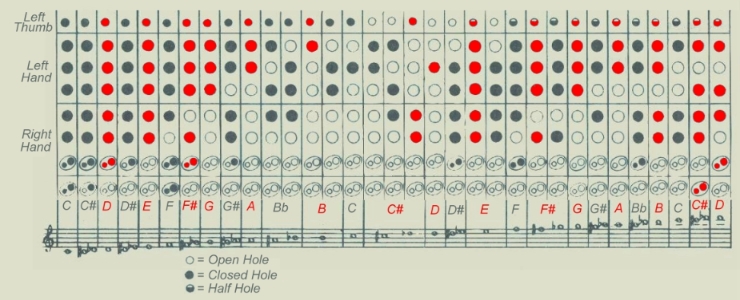
Not only is it a fairly simple process to learn the fingerings for a C
Recorder (if you already play a D whistle), but you will now be able to play down to low
C# and low C by using your previously neglected right pinkie finger (how many times have
you wished that your whistle would play just one or two notes lower...). Of course, it's
also a simple matter to play songs that are written in the key of C - you don't have to
use half-hole fingerings to play F natural and C natural (except the half-hole thumb in
the upper register).
~ Yamaha Translucent Recorders - Key of C - See-through, Neon Color
~ Yamaha YRS-312B Recorder - Key of C - Imitation Rosewood Rottenburg-style
~ 30 Irish Tunes for Easy Recorder
